The Akrus Business guide
Sell in reais. Save in dollars.
From your company's first Pix to its first dollar.

November 2026 · 33 min read

A piece to read slowly, start to finish, before you touch the company's cash. If you'd rather skip ahead, the table of contents takes you straight to what matters.
First things firstWhat you already feel in your gut
If you run a company and get paid by Pix (Brazil's instant payment system), you've felt this already, even if you've never put it into words.
The month goes by and the money comes in bit by bit. A Pix in the morning, another in the afternoon, one from a customer who paid right away, another from someone who only paid after the second WhatsApp message. On the bank statement, it's a line of names and amounts that someone has to check, one by one, against the spreadsheet. You know who that someone is. Sometimes it's you.
Then the end of the month arrives. First, taxes, in an amount that always seems bigger than it should be. Then the bills: suppliers, payroll, rent, the installment on that piece of equipment. You pay everything in reais, like you always have. And whatever is left over stays there, in the account, waiting for the next month. And the next. And the next.

Meanwhile, those idle reais buy a little less every month. No charge, no warning, no line on the statement.
None of this is a disaster. It's just how things work. And that's exactly why almost nobody does the math on what it costs.
This guide is about that math. And about a question that comes right after it: what if the part that's left over, after taxes and bills, could go into dollars, in the company's own wallet, without changing anything for your customer and without changing how you pay the bills?
Let's take it slowly. First, the path. Then, the numbers. Only then does Akrus Business enter the conversation, and you decide whether it makes sense for your company or not.
Chapter 1The path your money takes today
Think about your company's last month. The customer paid in reais, by Pix. Simple, fast, no card machine. Nothing to improve so far.
The money landed in the bank. At the end of the month, taxes went out from there. The bills went out. And what was left stayed where it was, waiting.
Today's path
That path has a price. And it shows up in different ways.
What goes out: taxes and bills
Taxes are high, and bills are bills. No new account changes that, and be wary of anyone who says otherwise. Akrus Business doesn't touch your taxes or do tax planning. That's a matter for your accountant.
What can improve is something else: knowing, before the month closes, how much came in, how much already has somewhere to go and how much will be left over. When that information is scattered across the bank, WhatsApp and the spreadsheet, the end of the month becomes a scare.
What's left over, sitting idle
This one doesn't show up on any statement.
Reais saved without earning anything lose purchasing power to inflation every month. It's not a charge, there's no line on the statement, nobody sends a notification. The balance keeps showing the same number. It's just that the number buys less with each passing month. In chapter 4, you'll see how much, with official figures.

Taxes and bills show up on the statement. What inflation eats from the surplus shows up nowhere.
And two more, smaller ones, that every owner knows
There's also the cost of your team: the hours spent checking Pix payments, chasing late payers and building spreadsheets. And the cost of getting paid: card machine, payment link, boleto (Brazilian bank slip) or the bank's Pix fee, for those who pay any of them.
None of these costs is a scandal on its own. Together, they are the price of a path nobody designed on purpose. It took shape over time, and it stuck.
The honest question is: how much does this path cost you? Not an average company, not an example. You.
Chapter 2Do your own math
Before talking about any product, it's worth doing the math with your own numbers. It takes five minutes and the statements from the last few months.

The idea is simple. Look at how much is usually left over each month, after taxes and bills. Look at how long that money sits idle before it has somewhere to go. Apply the inflation for that period. The result is how much purchasing power the surplus loses, without anyone having to press a single button.
Let's use Renata as an example. She's a partner in a distributor of beauty salon products: she sells to salons in the city and the surrounding region and gets paid almost entirely by Pix, at the bank, with no fee.1 Last month, about R$180,000 came in. Taxes went out, close to R$14,000. Suppliers, payroll and rent went out, about R$156,000. R$10,000 was left over, as in almost every good month.
That surplus has no immediate destination. It's the company's reserve: for the slow month, for the renovation, for the unexpected. In a little over a year, it passed R$100,000, sitting idle in the account.
Her math looks like this:
- Every R$10,000 that sits idle for 12 months loses about R$503 in purchasing power. Idle for 24 months, R$981.
- The R$100,000 already sitting idle loses about R$5,034 a year.2
None of these amounts shows up on her statement. The balance still says R$100,000.
A word of caution before moving on. Every company has different math. Some have no surplus at all at the end of the month, and some already invest their reserve in reais, earning a return. Some get Pix for free at the bank and some pay for a card machine or payment links. That's why the calculator asks for your numbers, and not an average market number. We don't have that average number, and we're not going to make one up.
With your own math in hand, you can look at the alternative with the eyes of someone deciding, not someone being persuaded.
Chapter 3Keep the operation. Change the destination.
Here's the sentence that sums up everything that follows: with Akrus Business, you sell the way you already sell and pay the bills the way you already pay them. The difference is where the surplus goes.
Same Pix. Same customer. Same taxes. Same bills.
For your customer, nothing changes
The person paying gets an ordinary Pix, in reais, and pays it in their bank's app. They don't download anything, don't create an account, don't see the word "dollar" anywhere. From their point of view, it's the same Pix as always.
This matters more than it seems. Any change that asks the customer for a new step costs sales. This one doesn't ask for any.
For your company, the destination changes
The month's money stays in reais: that's where taxes, suppliers, payroll and rent come from. What's left over can stay in reais or go as digital dollars (USDc) to the company's wallet.
Digital dollars (USDc) are a digital currency designed to track the US dollar, one to one. They sit in a wallet that belongs to your company, with an address only your company uses. We talk more about them in chapter 4.
And control changes
The third change is the one your team feels first. Who paid, how much came in and where it went now live on a single screen. No side spreadsheet, no hunting for receipts on WhatsApp. And it gets easier to see, before the month closes, how much will be left over.
What it is, in one sentence
If you need to explain it to your business partner, here's the full definition: Akrus Business is the company account that charges by Pix, receives in reais or in digital dollars (USDc) and organizes customers and finances in a single dashboard.
It does four things. One at a time.
Charge
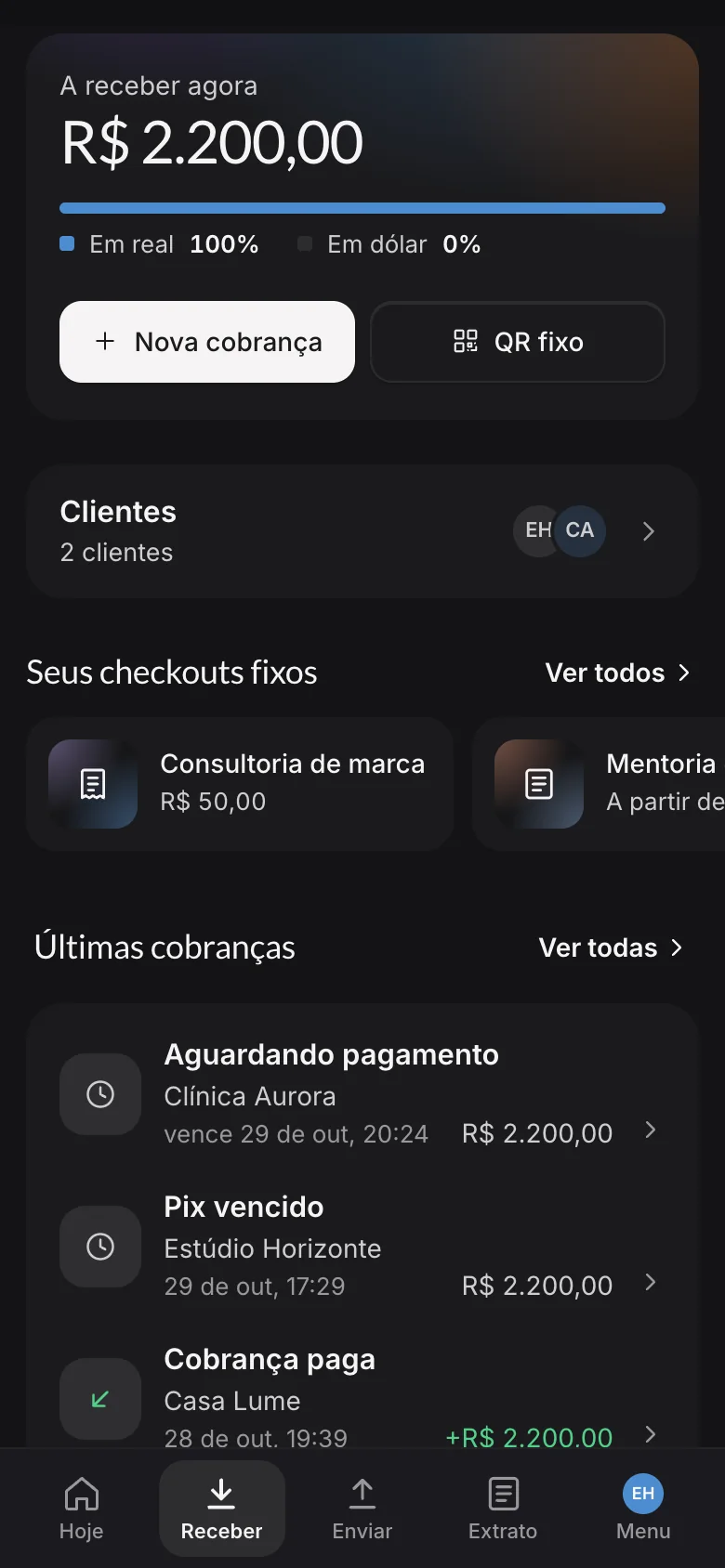
You charge the way you already sell, with no card machine, no boleto and no sign-up for the person paying. Do you sell by order or proposal? A payment link with an amount and due date, sent by WhatsApp or email, tracked until confirmation. Do you serve customers at a counter? A printed fixed QR that never expires and where the payer types in the amount. Do you always sell the same service? A fixed checkout, with the price saved and the same link for everyone. The minimum amount for a charge is R$2.
Choose the currency
When you create the charge, you choose the destination: in reais, in the account, or straight to the company's wallet, in dollars. The customer doesn't see that choice. On the Gold (Ouro) plan, for example, a R$2,200 Pix becomes R$2,133 in reais, or about US$397 in the wallet on the same business day.3
The same Pix, seen from both sides
What the customer sees
Pix to Estúdio Horizonte
R$2,200.00
Paid in the bank app, no sign-up
✓ Pix completed
What your company decides
Pix received
R$2,200.00
or
Use the money
The reais that stay in the account wait in the company's balance until you decide. Withdraw (Sacar) requests a transfer to your Pix key, and Akrus checks it before sending. Send Pix (Enviar Pix) pays a supplier straight from the balance. These are the ways the month's bills keep going out in reais. Taxes you keep paying the way you pay them today, through the company's bank account.
And when there's a surplus, Convert (Converter) moves reais into dollars, whenever you choose. To put reais into the account, today you create a charge to your own company and pay it from your bank. Each of these paths is explained, with timing and cost, in chapter 5.
Keep track
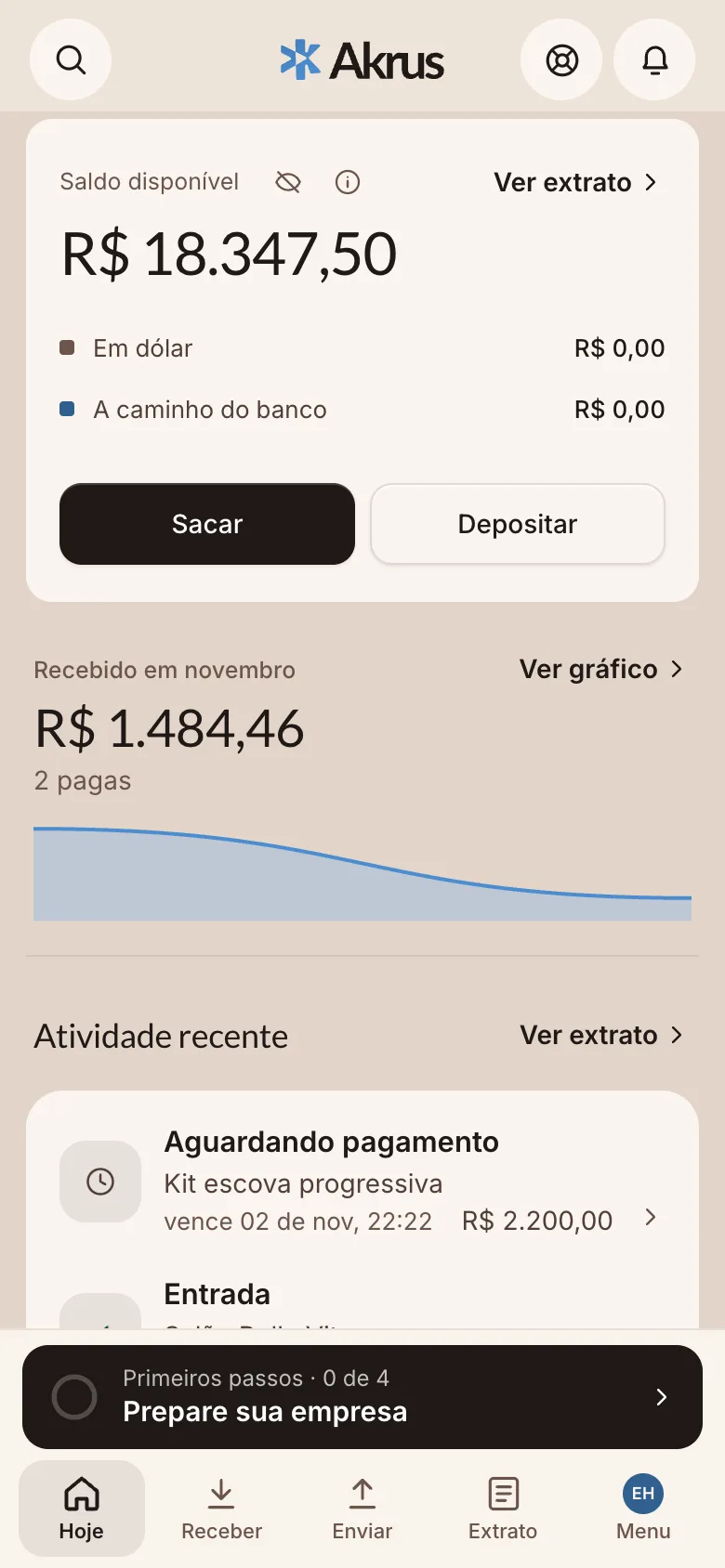
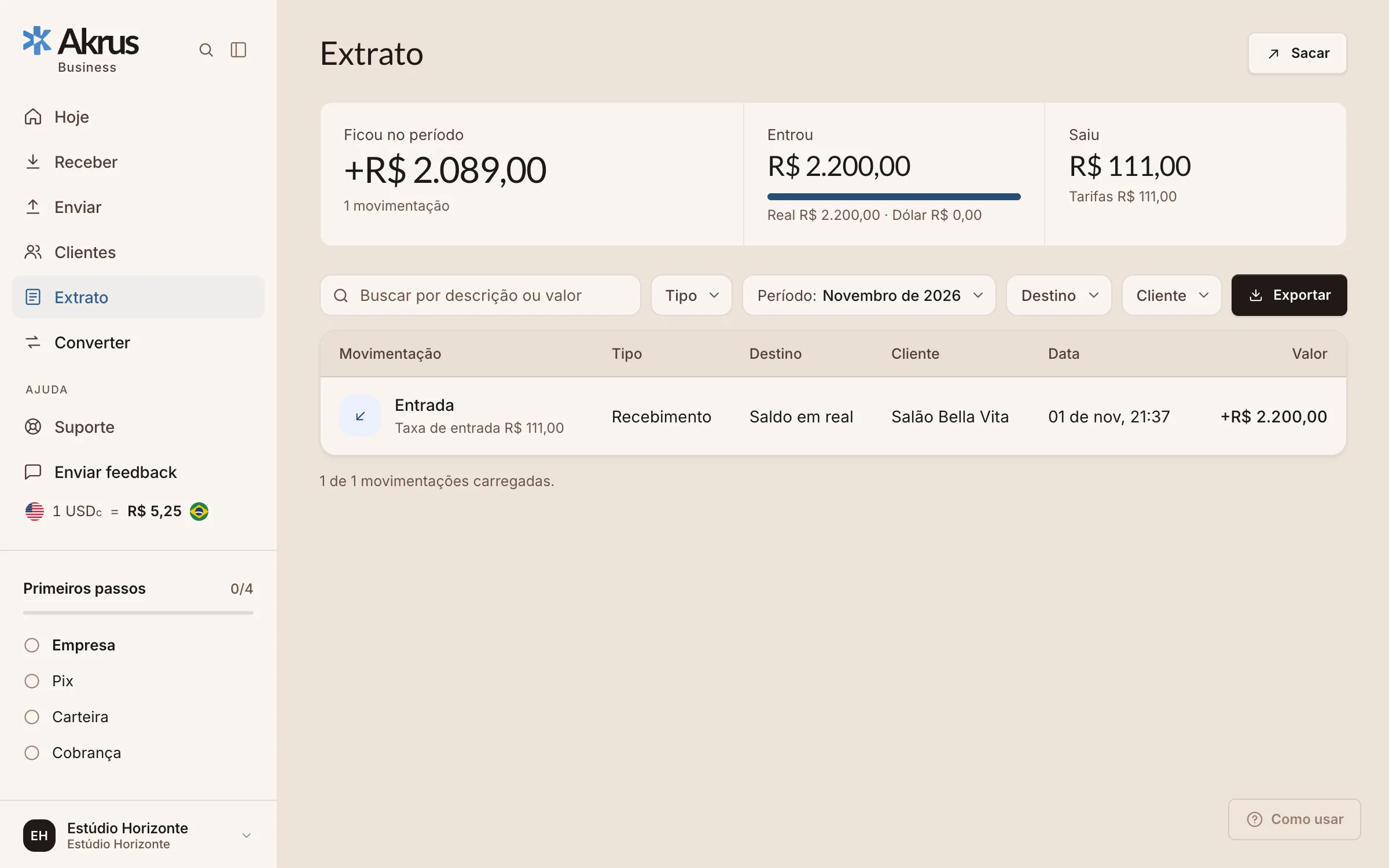
Remember the end-of-month scare? This is where it can shrink. Today (Hoje) shows the day's payments, the balance and the latest money in. Customers (Clientes) shows who paid, who hasn't and how much is outstanding. Statement (Extrato) shows money in, money out and fees, with export, receipts and dollar orders. On the phone, one tap hides the amounts on screen. We don't measure how many hours you'll save; that depends on how your team works today. What changes is that information scattered across the bank, WhatsApp and the spreadsheet ends up on a single screen.
Two ways to start
You don't have to change everything at once. Akrus Business works in two ways, and the math for each is in chapter 7.
- Surplus only. You keep getting paid at the bank, as today, and paying taxes and bills from there. At the end of the month, you create a charge on Akrus to your own company for the amount left over, pay it from your bank, and convert it to dollars. Getting paid doesn't change at all.
- Everything through Akrus. You start charging customers through Akrus. Bills go out in reais from the balance, and the part that's already reserve goes into dollars, on the charge itself or later, through Convert.
And Akrus Business doesn't ask for three things that usually stop people who think about dollars: a bank account abroad, a card machine and a monthly fee. It's a product independent from Akrus Digital, with its own domain, accounts and login.
When Renata first heard this, she asked the question everyone asks: "Okay, but why would I save in dollars? I sell in reais, I pay in reais." The answer deserves a whole chapter, with official numbers. And with a part almost nobody shows.
Chapter 4Why dollars, and why not as a bet
Let's start with the leak that doesn't show up on the statement.
Idle reais lose value
In September 2016, R$1,000 bought a certain amount of stuff. In September 2026, to buy exactly the same amount, you'd need R$1,623. Put the other way around: R$1,000 saved in 2016 buys today what R$616 bought back then.
That's Brazil's official inflation, the IPCA, measured by the IBGE (Brazil's national statistics institute). Over ten years, it added up to 62.3%. Money sitting idle in reais, earning nothing, lost 38% of its purchasing power in that period. Over five years, from September 2021 to September 2026, the IPCA was 29.5%, and the loss, 23%.
What R$1,000 from 2016 buys
Earning nothing, measured each September
Remember line A of your math, the surplus? That's what this number works on. Renata's R$100,000 doesn't disappear. It just buys less, a little more each month.
An important caveat: this math compares with idle money, earning nothing. An investment in reais that earns a return changes the result, and this guide doesn't claim the dollar beats it. We're talking about the balance that sits in the account, waiting.
The real against the dollar
Now, the same window looking at the exchange rate. In September 2016, US$1 cost R$3.25. In September 2026, R$5.18. The dollar rose 59.6% in reais. Or, from the point of view of someone saving in reais: in ten years, the real lost 37% against the dollar.
Anyone who saved R$1,000 in dollars in 2016 had, in 2026, the equivalent of R$1,596. Adjusted for Brazilian inflation over the period, that preserves 98% of the original purchasing power. Almost all of it.
What US$1 cost in reais
Selling PTAX, last business day of September
Points joined by straight lines; not the daily series.
The part almost nobody shows
Look at the chart again. Between September 2021 and September 2026, the line goes down. The dollar went from R$5.44 to R$5.18. It fell 4.8% against the real.
Over that five-year period, those who saved in dollars did worse than those who left their reais idle. R$1,000 in reais from 2021 buys today the equivalent of R$772. The same R$1,000 in dollars buys the equivalent of R$736.
We show this because it's true, and because a guide that only showed the good window would be selling a bet. The dollar moves up and down. Over short periods, it can fall. Over ten and fifteen years, history favored the dollar. Over five, it didn't.
R$1,000 saved, by what it buys today
In idle reais or in dollars, since the start of each window
The dollar is not a short-term bet. It's a place for the reserve that will stay put for years.
The dollar has inflation too. Less of it.
No currency is immune. Over the same ten years, prices in the United States rose 39.6%, according to the US government's official index. In Brazil, 62.3%. Over five years, 22.8% there and 29.5% here.
Cumulative inflation, here and there
Through September 2026, same scale
So, why dollars?
Not because it always goes up. It doesn't always go up, and we just showed that. And not because your company pays for anything in dollars. It probably doesn't.
The reason is the surplus. The money for taxes and bills has a date to go out, and it should stay in reais. The surplus doesn't. It sits idle for months, sometimes years, losing to Brazilian inflation. The question is where to keep this money that's in no hurry.

There's a detail worth understanding, because it changes the decision. Saving in dollars doesn't take your reserve out of Brazilian inflation: what you'll buy with it still costs reais. What separates idle reais from dollars is the exchange rate. When the real loses value against the dollar, the reserve in dollars makes up for it. Over ten years, the exchange rate made up for almost all of the inflation here. Over five, it didn't.
And over the long run, keeping the reserve in a currency with lower inflation helped preserve purchasing power. That's history, not a guarantee.
To make clear what digital dollars (USDc) are and what they aren't:
- They are a digital currency designed to track the US dollar one to one, kept in your company's wallet.
- They are not an investment. They don't earn interest. And the dollar moves up and down, as the last five years show.
With that settled, the next question is practical: what exactly can you do with each real that comes in?
Chapter 5Four paths for every Pix
Every Pix that comes into Akrus Business has four possible paths. You choose per charge and can change whenever you want. Today's charge doesn't decide tomorrow's.
Four paths for every Pix
The amount is reserve from the start.
On the same business day, after approvalTaxes, bills and suppliers.
Stays in the balance until you request itMoves reais to the company's account, or pays someone from the balance.
Requested right away, sent after approvalPaid the bills and want to move the surplus into dollars.
Whenever you wantA charge has only one destination. To get part of each, use charges with different destinations or convert later.
Let's go through each one.
Straight to wallet, in dollars
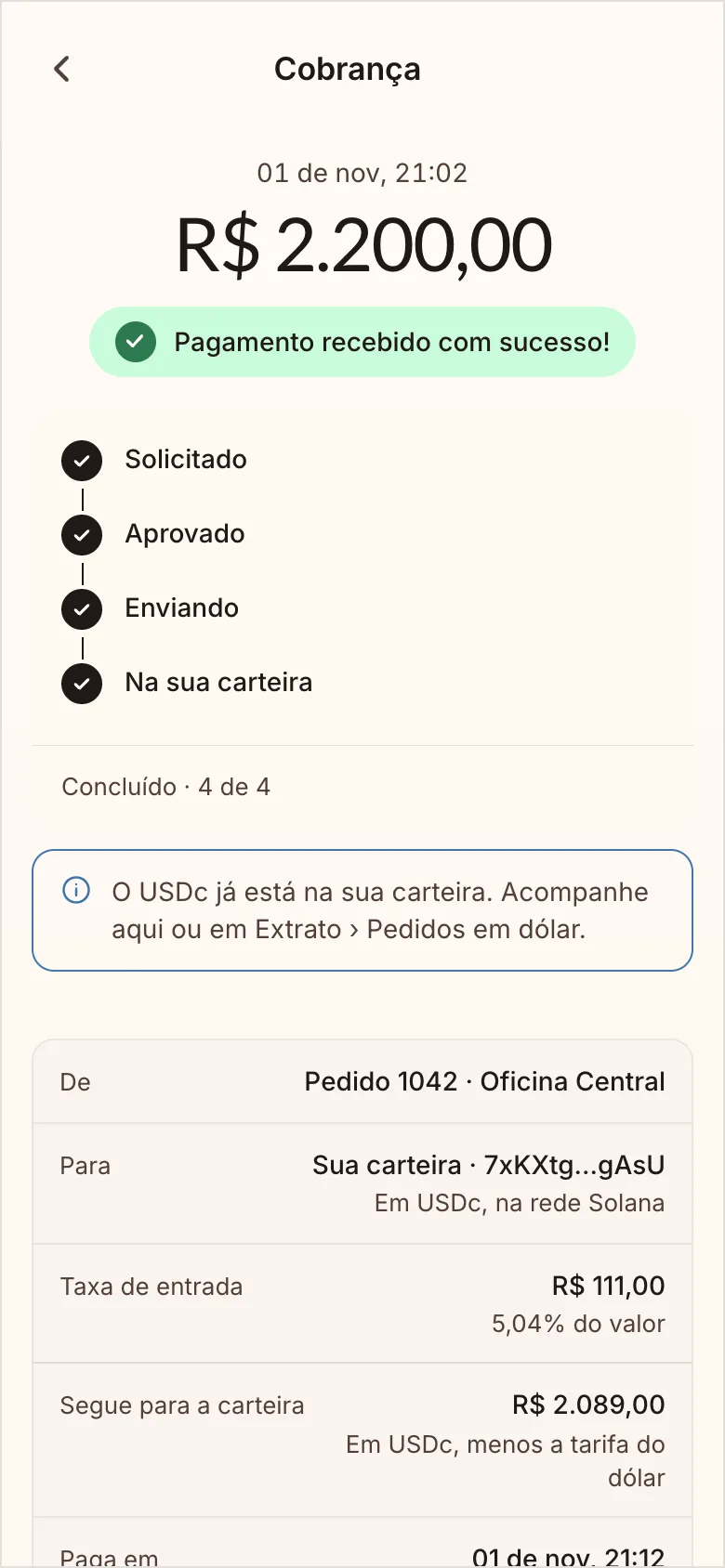
This is the path that gives this guide its name. When you create the charge, you choose Straight to wallet (Direto na carteira). When the customer pays the Pix, Akrus converts the amount into digital dollars (USDc) and sends it to the company's wallet.
When to use it: when that amount is reserve from the start. A big sale that won't pay any of the month's bills, for example.
What you need to know first:
- Timing. On the same business day as the payment, after the transfer is approved. It's not instant, and we'd rather tell you here than have you find out later.
- Cost. Your plan's fee on Pix received and the plan's dollar fee, from 0.5% to 1.25%. On this path, the dollar fee doesn't include the fixed R$1.
- Minimum amount. R$100 per charge, with the wallet registered and the company verified.
- The wallet belongs to the company. It's a USDc wallet on the Solana network, registered by you. The address is checked in blocks before saving, so that one wrong character doesn't send the money somewhere else.
- Where to track it. On the charge receipt or in the Statement, under Dollar orders (Pedidos em dólar).
And what if something goes wrong along the way? If the wallet was changed after the charge, if the plan hit its limit or if the company's verification is still pending, the amount isn't lost. It stays in the balance in reais, and the receipt says why.
In reais, for the month's taxes and bills
Not every real needs to become a dollar. Most shouldn't. Taxes, suppliers, payroll and rent are in reais, and that money has to stay in reais and arrive quickly.
When you don't choose the wallet, the amount stays in reais in the company balance, on Akrus. It doesn't leave on its own: there's no automatic transfer at a fixed time. When you need the reais outside Akrus, you request them through Withdraw or pay directly with Send Pix.
Withdraw or Send Pix
These are the two ways to take reais out of Akrus: move them to the company's account or pay someone directly, without going through the bank.
- Withdraw requests a transfer of the balance to your Pix key. The request is made right away; the transfer happens after Akrus checks it.
- Send Pix pays the supplier or service provider straight from the balance, using their Pix key, within the plan's limit.
Each outflow in reais pays the plan's withdrawal fee, from 0.5% to 2.5%, plus R$1.
Convert later, and putting reais into the account
The fourth path is the most common for those thinking about the surplus. You only know how much is left after paying taxes and bills. Then you decide how much to move into dollars.
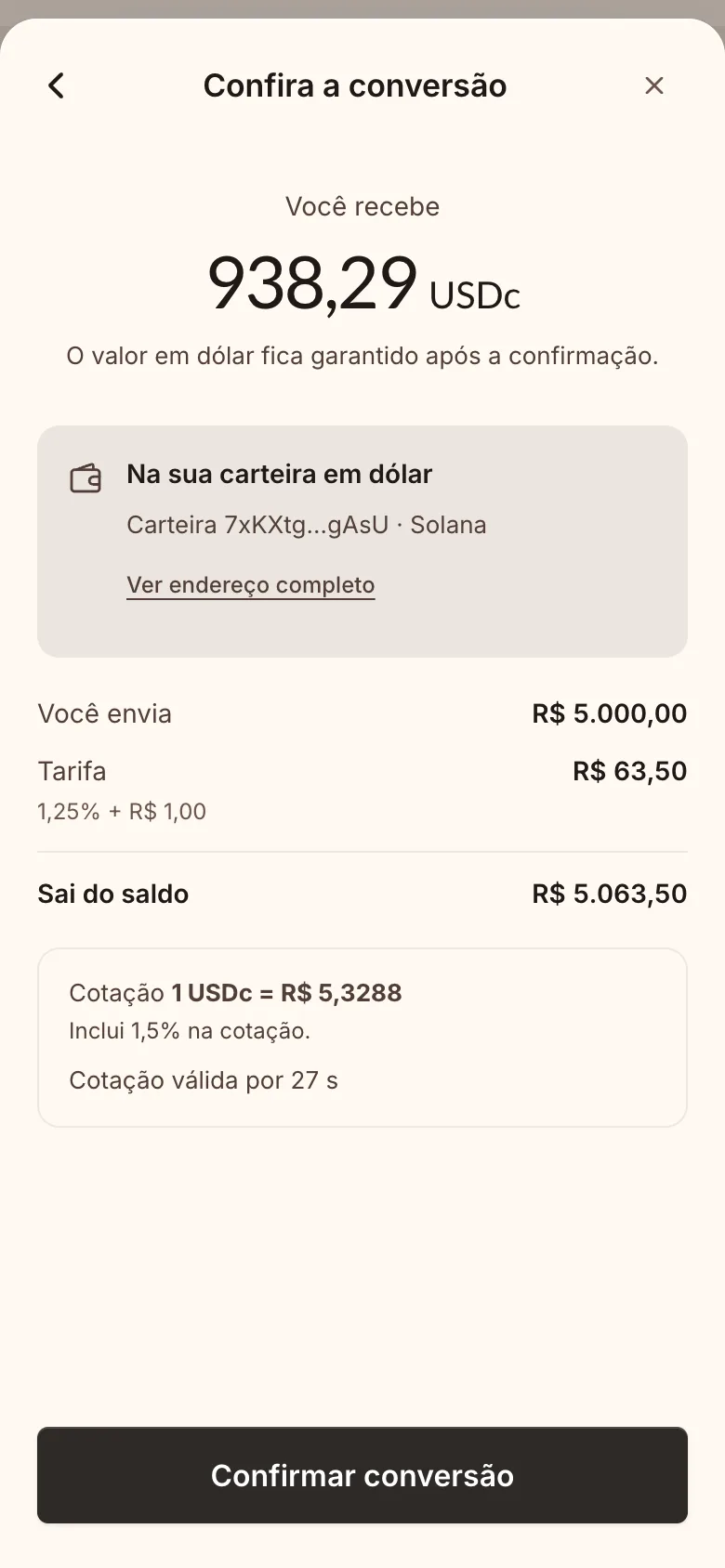
Convert turns a balance in reais into digital dollars (USDc) and sends it to the company's wallet. The way it works was designed to avoid surprises:
- The rate appears on screen before you confirm, and stays locked for 30 seconds. The screen also shows the fee and how much comes out of the balance.
- How it's set: the higher USDc rate in reais between two exchanges, Binance and Foxbit, plus Akrus's 1.5% margin. The margin is built into the rate you see.
- Fee: the plan's digital dollar withdrawal fee, from 0.5% to 1.25%, plus R$1.
- Minimum amount: R$2. Once confirmed, the transfer follows the same trail as Straight to wallet.
And what if the surplus is at the bank, not on Akrus? Today, to put reais into the account, you create a charge to your own company and pay it from your bank. It lands in the balance like any charge, with the plan's incoming fee, and from there you convert. It's the "surplus only" way from chapter 3.
"What if I want half of each?"
This question always comes up, and the answer has to be exact. Each charge has only one destination: it stays entirely in reais or goes entirely Straight to wallet. Today there's no option that splits a single charge into percentages.
Getting part of each works in two ways. Either you use different destinations on different charges (the big sale that's already reserve goes to the wallet, the everyday ones stay in reais). Or you receive everything in reais, pay the bills and convert the surplus whenever you want. That's what Renata does, and you'll see her math in chapter 6.
Chapter 6Three companies, three sets of numbers
Rules are useful. Examples are more convincing. Here are three Brazilian companies that sell in reais and pay their bills in reais, with each one's full math, from Pix to dollars.4
The distributor: gets paid at the bank, saves the surplus in dollars
Back to Renata.
She didn't change how she gets paid. The salons keep paying the Pix into her bank, with no fee. Taxes and bills keep going out from there.
What changed was the end of the month. After paying everything, she creates a R$10,000 charge on Akrus Business to her own company, pays it from the bank, and converts the balance to dollars. On the Free (Grátis) plan:
- Incoming: 6% plus R$1, or R$601. R$9,399 stays in the balance.
- Convert: R$9,281.98, with a R$117.02 fee and the 1.5% margin already included in the rate. In the wallet: about US$1,742.
Akrus's fees add up to R$718.02. Adding the margin built into the rate as well, the total cost was about R$855, or 8.6% of the surplus. The wallet received the equivalent of R$9,145 at the reference rate.
The example uses the Free plan, and R$10,000 a month fits within its limit. On the other plans, the incoming fee is lower; the table in chapter 7 shows each one.5
Renata's month and the surplus's path
Free plan, illustrative example
The month, at the bank: ≈ R$180,000
The R$10,000 surplus, all the way to dollars
Not a customer. Free plan. Dollar at R$5.25 plus 1.5% margin, for reference only.
And here comes the frank part. Over one year, R$855 is more than what inflation eats from the same R$10,000 sitting idle, about R$503. For Renata, it only makes sense because that surplus is a reserve for years, not money for this month. And even so, the result depends on the exchange rate, as chapter 4 showed. In chapter 7, you'll see this math for each plan.
The farm: few sales, high amounts, part of it becomes reserve
Now, a business of a different size. A cattle farm in Brazil's Center-West sells a few lots a month, each one worth a lot. The money from each lot pays for months of feed, payroll, freight and taxes. And, in a good year, there's a surplus.
Each lot becomes a payment link with a fixed amount and the buyer's name, and the buyer pays by Pix from their bank. The lots that will pay the bills stay in reais. The lot that is reserve from the start is charged Straight to wallet.
A R$180,000 lot Straight to wallet, on the Diamond (Diamante) plan:
- Incoming: 2% plus R$1, or R$3,601.
- Dollar fee: 0.5%, or R$882.
- In the wallet: about US$32,938, on the same business day as the payment.
Fees: R$4,483, or 2.5% of the lot.
With two lots a month, one in reais for the bills and one Straight to wallet, the farm pays R$8,084 in fees on Diamond. On Gold, it would pay R$12,024.19, or R$3,940.19 more a month.
The statement and receipt for each lot stay together, by buyer. When the accountant asks, it's all in one place.
The counter store: lots of small sales, a little into dollars each month
The third example is the opposite of the farm. A hardware store in a busy neighborhood sells all day long, almost entirely by Pix.
A fixed QR sits on the counter. The buyer types in the amount and pays with their bank's app. Each sale shows up instantly on the owner's phone. The reais go toward the store's bills. Once a month, after taxes and bills, the owner moves part of the balance into dollars.
A day with 40 sales, average ticket of R$180, on the Gold plan:
- The day's incoming fees: R$256 (40 sales × R$6.40). R$6,944 remains, which goes in reais toward the bills.
- At the end of the month, Convert R$5,000 from the balance: R$4,964.25 converted, with a R$35.75 fee and the 1.5% margin in the rate. In the wallet: about US$932.
An honest detail: the fixed R$1 weighs more on a small sale. On a R$180 sale, the incoming fee on Gold is 3.6%. On a R$50 one, 5%. If the counter Pix is free at the bank today, this fee is a new cost, and the store needs to see value in tracking each sale to pay for it.
Chapter 7What it costs, no fine print
We've reached the part you've been waiting for since chapter 2. Let's put everything on the table.
Four plans, the same account
Every plan charges by Pix, receives in reais and in dollars and has the full dashboard. What changes is the fee and how much the account can move each month.
Akrus Business plans
akrus.business/planos, checked on Nov 21, 2026
| Free | Silver | Gold | Diamond | |
|---|---|---|---|---|
| Monthly fee | None | None | None | None |
| Per Pix received | 6% + R$1 | 4% + R$1 | 3% + R$1 | 2% + R$1 |
| Withdrawal in reais | 2.5% + R$1 | 1.5% + R$1 | 1% + R$1 | 0.5% + R$1 |
| Withdrawal in digital dollars | 1.25% + R$1 | 0.75% + R$1 | 0.7% + R$1 | 0.5% + R$1 |
| Monthly incoming | up to US$6,000 | up to US$60,000 | up to US$300,000 | above that, under review |
Down to the last cent: R$10,000 received on Gold and sent Straight to wallet pays R$301 in incoming fees and R$67.89 in dollar fees. Total: R$368.89, or 3.7%. Plus the rate at that moment.
The details that usually stay hidden are out in the open here:
- No plan has a monthly fee. Plans are switched from the dashboard.
- Above R$5 million a month, the fee is negotiated.
- Limits per transfer and per day are at akrus.business/planos. On Free, each transfer goes up to US$2,000.
- Above the monthly cap, a new charge is declined before the Pix even exists. Nothing is held.
The whole cost, from Pix to dollars
The "3.7%" above is true, but it's not the whole math. To compare fairly, you have to add up everything between the reais coming in and the dollars in the wallet: the incoming fee, the dollar fee and the 1.5% margin built into the rate.
The cost of moving reais into dollars
By plan, without the fixed R$1
| Free | Silver | Gold | Diamond | |
|---|---|---|---|---|
| Total cost, from Pix received to dollars in the wallet (incoming + dollar fee + 1.5% margin) | 9.3% | 6.5% | 5.4% | 4.1% |
| Of every R$100 that comes in, what reaches the wallet, at market price | R$91.5 | R$93.9 | R$94.9 | R$96.1 |
| Only the dollar part, when the reais are already in the balance (dollar fee + margin) | 2.8% | 2.3% | 2.2% | 2.0% |
Without the 1.5% margin, the total cost would be: Free 7.7%; Silver 4.9%; Gold 3.8%; Diamond 2.6%.
Notice the two readings of the table, because they match the two ways of using the account.
- Surplus only. You pay the total cost in row 1, because the surplus enters Akrus through a charge. In exchange, the way you get paid doesn't change at all.
- Everything through Akrus. The incoming fee becomes the price of charging and getting paid through Akrus, and it applies to all the money, including what stays in reais. Then, moving the surplus into dollars costs only row 3, around 2%. But the incoming fee on all your revenue has to make sense on its own: compare it with what you pay today to get paid, line D of the calculator.
Cost against inflation, no shortcuts
Now, the honest comparison. The dollar cost is paid once. Inflation eats the surplus every year. Except, as we saw in chapter 4, saving in dollars doesn't take the reserve out of Brazilian inflation; the exchange rate decides. So the right question is: after paying the whole cost, how would the reserve have done in each window of recent history?
R$1,000 saved, after the cost of moving into dollars
By what it buys today (Sep 2026), since the start of each window
| Idle reais | Dollar on Free | on Silver | on Gold | on Diamond | |
|---|---|---|---|---|---|
| 5 yearssince Sep 2021 | R$772 | R$673 | R$691 | R$698 | R$707 |
| 10 yearssince Sep 2016 | R$616 | R$899 | R$923 | R$933 | R$944 |
| 15 yearssince Sep 2011 | R$436 | R$1,114 | R$1,143 | R$1,156 | R$1,170 |
With no cost at all, the dollar would give R$736, R$983 and R$1,218 (figure 7). Does not include fixed fees or taxes. Sources: IBGE (IPCA) and Banco Central (selling PTAX), retrieved Nov 2, 2026.
The table says two things, and both are true. Over five years, idle reais beat every plan, because the dollar fell and there was still the cost to pay. Over ten and fifteen years, the dollar beat them all, even after the whole cost of the Free plan.
In Renata's math, with the calculator: over 12 months, no dollar scenario reaches idle reais, because the cost hasn't paid for itself yet. Over 24 months, it depends on the exchange rate. If the dollar keeps the pace of the last ten or fifteen years, it comes out ahead. If it stays flat, or follows the pace of the last five, it falls behind.
We'd rather you read this here than find it out on your own later.
Akrus Business doesn't promise gains in dollars, doesn't promise an exchange rate cheaper than your bank's and doesn't touch your taxes. What it changes is something else: the company's surplus can go into dollars, in the company's own wallet, with no bank account abroad and nothing changing for the customer; and who paid, how much came in and where it went all live on a single screen.
So, when does it make sense?
- When the surplus is a reserve for years, not money for the next few months. The longer it stays saved, the more the entry cost gets diluted. For money needed in a few months, it doesn't pay off.
- When you already pay to get paid, or want to charge and keep track through Akrus. Then the incoming fee replaces a cost that already exists, and the dollar part stays around 2%.
- When you accept that the dollar moves up and down. Over five years, it lost. If you need the reserve intact in reais on a specific date, you shouldn't keep it in dollars.
And when doesn't it make sense? The money for the next few months' taxes and bills stays in reais, always. If your company has no surplus, or already invests its reserve in reais with a return and is happy with it, the math may not work out, and this guide doesn't claim the dollar beats an investment. And that's fine. The calculator exists so you can find that out before opening the account, not after.
Chapter 8Which plan is yours
No plan has a monthly fee. So choosing a plan is no longer a break-even calculation between a monthly fee and per-transaction fees.
What changes from one plan to the next is in the table in chapter 7: the fee on each transaction, which drops from Free to Diamond, and how much the account can move each month. Above R$5 million a month, the fee is negotiated.
Before choosing, check each plan's monthly incoming cap and per-transfer limit, listed at akrus.business/planos. Large lots, like the farm's, call for attention to the per-transfer limit. Plans are switched from the dashboard.
Chapter 9Can I trust my cash to this?
Every serious conversation about money ends up here. And it should. You're thinking about running the company's reserve, or all of its incoming payments, through a new account. The right question isn't "does it look nice?", it's "is it safe?".
The short answer: the account belongs to your company, and so do the dollars. The long answer is five facts, all about what's live today.
Access. The account is opened with the company's email, confirmed by link. The login is its own, separate from Akrus Digital. Every feature that moves money is only unlocked after it's confirmed for your company.
The dollars are yours. They go to the wallet the company registered, checked in blocks before saving. Akrus doesn't keep them.
Discretion. The person paying sees an ordinary Pix. They don't see the company's wallet or what you do with the money afterwards. And on the phone, one tap hides the amounts on screen. A note of honesty: USDc transfers on the Solana network are recorded on a public network. That's why we talk about discretion, not secrecy.
Limits. Above the plan's cap, the charge is declined before the Pix even exists. Your customer's money is never held because of a limit.
Who we are. Akrus Business is in the process of establishing its headquarters in Nevis, in the Caribbean.
Chapter 10What you'll want to know
The questions every owner asks before deciding, with short answers. Anything else, at ola@akrus.digital.
Does Akrus help me pay less in taxes?
No. Akrus doesn't touch your taxes or do tax planning. Taxes keep being paid in reais, as today. If a dollar reserve has tax implications for your company, your accountant is the one to answer.
Do I need to change how I get paid?
No. You can keep getting paid at the bank and run only the month's surplus through Akrus.
Do I need a bank account abroad?
No. The dollars go as digital dollars (USDc) to the company's wallet.
Does my customer see the dollars or have to sign up?
No. They pay an ordinary Pix, in reais, in their bank's app.
Does saving in dollars protect against inflation?
Not always. Over ten years, the exchange rate made up for almost all of Brazilian inflation. Over five, the dollar fell 4.8% and idle reais did better. It's history, not a promise.
Is this an investment?
No. USDc doesn't earn anything. And there's no card or boleto: charges are by Pix.
How much does it cost to move the surplus into dollars?
From Pix to dollars, adding the incoming fee, the dollar fee and the margin, from about 4% to 9% depending on the plan. If the reais are already in the Akrus balance, only the dollar part, around 2%. The full math is in chapter 7.
Can I split a charge, part in reais and part in dollars?
Each charge has only one destination. To get part of each, use charges with different destinations or convert as much as you want later.
Is Withdraw instant?
The request is made right away. The transfer happens after Akrus checks it. There's no automatic transfer at a fixed time: the reais stay in the balance until you request them.
Who can open an account?
The account belongs to the company. At sign-up, it accepts a CNPJ or CPF.
Chapter 11Start with R$5
At the end of the following month, Renata paid taxes and bills as always, through the bank. Then she opened her phone, charged her own company for the amount left over and sent it to the wallet. The bank balance kept the month's money. The reserve went into dollars.
She didn't start with the R$10,000. She started with R$5.

That's what we suggest for you too. No big decision, no implementation meeting, no customer money at stake. Create the account, set up how you get paid and charge yourself. In four steps, you see the money move with your own eyes.
- Create the account. With the company's email, confirmed by link.
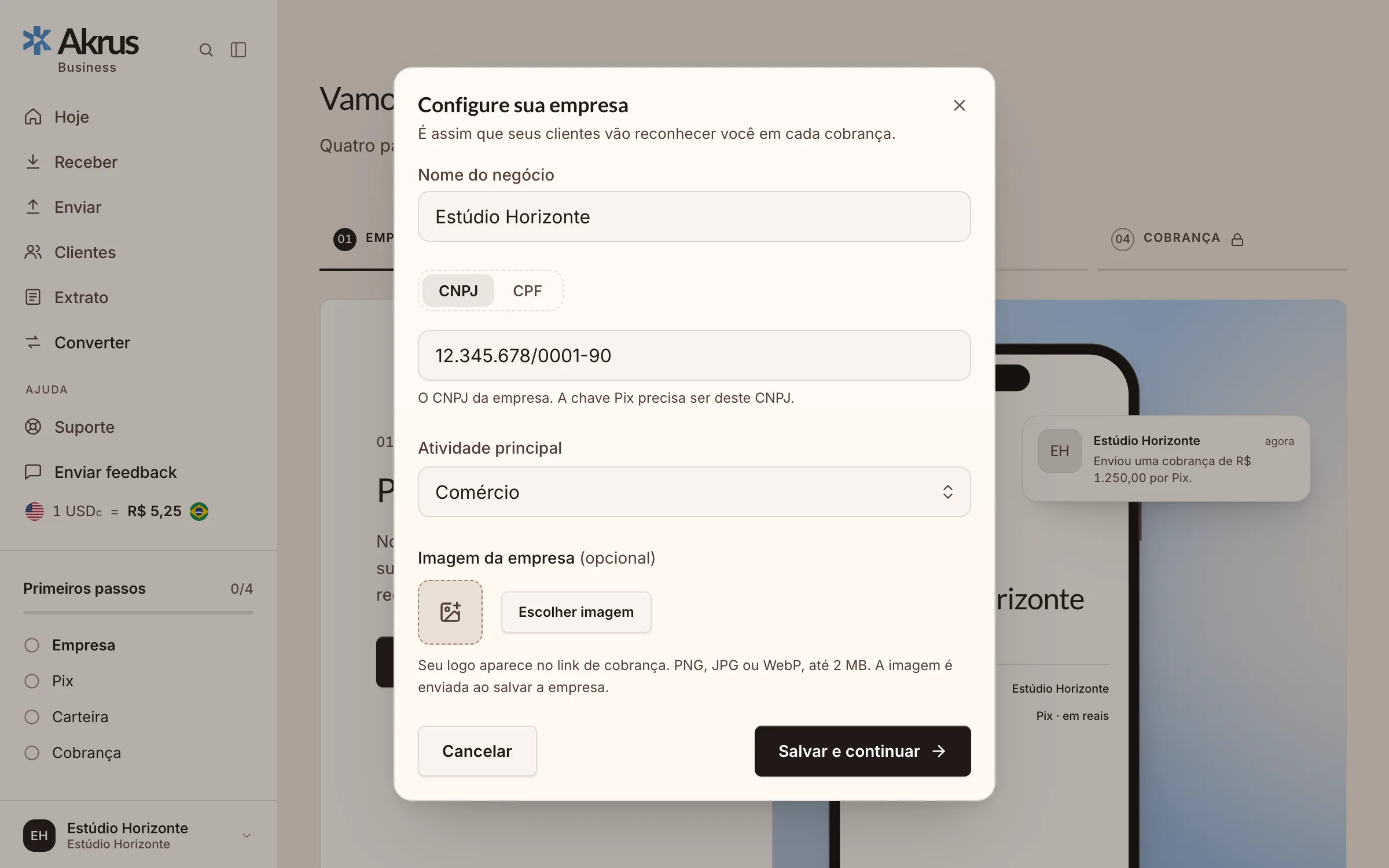
- Company details. CNPJ or CPF and verification, in the app itself.
- Pix and wallet. The key that receives reais and the wallet that receives dollars.
- First charge. A R$5 Pix to yourself, paid from your bank. The app guides every field.
After the test, you know how your customer will see the charge, how long the money takes and where every real shows up. Then, and only then, you decide the rest with your own math in hand.
Next step
Start with R$5
Create the account, set up how you get paid and charge yourself a R$5 Pix. In four steps, you see the money move.
Create the company account
Or point your phone's camera.
Questions? Talk to whoever sent you this guide or write to ola@akrus.digital.
Notes
- Renata and the distributor are an illustrative scenario, built from common situations of companies that get paid by Pix, pay taxes and bills in reais and end the month with a surplus. They are not a customer or a testimonial. The amounts in the scenario are illustrative too. ↩
- Inflation of 5.3% a year, the annual average of the IPCA from September 2021 to September 2026. R$10,000 × (1 − 1 ÷ 1.053) = R$503 over 12 months; R$10,000 × (1 − 1 ÷ 1.053²) = R$981 over 24 months; R$100,000 × (1 − 1 ÷ 1.053) = R$5,034 a year. ↩
- Sample values, Gold plan: R$2,200 − R$67 incoming fee (3% + R$1) = R$2,133; minus R$14.93 dollar fee (0.7%), converted at R$5.32875 (dollar at R$5.25 plus 1.5% margin, for reference only). The rate at the moment of the transaction applies. ↩
- The three examples are illustrative, built from common situations and from Akrus sales conversations. They are not customers or testimonials. Dollar at R$5.25 plus 1.5% margin, for reference only; the rate at the moment of the transaction applies. ↩
- Renata's math. Free: incoming fee of R$601 (6% + R$1); balance of R$9,399; converted (9,399 − 1) ÷ 1.0125 = R$9,281.98; fee of R$117.02; US$1,741.87 at R$5.32875; market value of R$9,144.80; total cost of R$855.20. ↩
Official sources and calculations
Data retrieved on Nov 2, 2026 from the official APIs. The October 2026 IPCA had not been released yet; every series compares September with September. History, not a promise. Digital dollars (USDc) aim to track the dollar one to one, with no guarantee.
| Data | Value | Source |
|---|---|---|
| IPCA index number Sep 2011 · Sep 2016 · Sep 2021 · Sep 2026 | 3,354.85 · 4,740.53 · 5,944.21 · 7,695.82 | IBGE, SIDRA table 1737, variable 2266 |
| Selling PTAX Sep 30, 2011 · Sep 30, 2016 · Sep 30, 2021 · Sep 30, 2026 · Oct 30, 2026 | 1.8544 · 3.2462 · 5.4394 · 5.1809 · 5.4212 | Banco Central, Olinda API CotacaoDolarPeriodo |
| CPI-U Sep 2016 · Sep 2021 · Sep 2026 | 241.428 · 274.310 · 336.940 | U.S. BLS, series CUUR0000SA0 |
- IPCA 10 years: 7,695.82 ÷ 4,740.53 = 1.6234 (+62.3%); R$1,000 ÷ 1.6234 = R$616. In 2021: 4,740.53 ÷ 5,944.21 × 1,000 = R$797. 5 years: ÷ 5,944.21 = 1.2947 (+29.5%); 1,000 ÷ 1.2947 = R$772 (a 23% loss). 15 years: ÷ 3,354.85 = 2.2939 (+129.4%).
- PTAX 10 years: 5.1809 ÷ 3.2462 = 1.5960 (+59.6%); real against the dollar: 1 − 3.2462 ÷ 5.1809 = 37.3%. 15 years: ÷ 1.8544 = 2.7938 (+179.4%). 5 years: ÷ 5.4394 = 0.9525 (−4.8%).
- CPI 10 years: 336.940 ÷ 241.428 = 1.3956 (+39.6%); 5 years: ÷ 274.310 = 1.2283 (+22.8%).
- R$1,000 in dollars, in today's purchasing power: 10 years 1.5960 ÷ 1.6234 = R$983; 5 years 0.9525 ÷ 1.2947 = R$736; 15 years 2.7938 ÷ 2.2939 = R$1,218.
- Product (reference dollar 5.25 × 1.015 = 5.32875): R$2,200 → 67 incoming → 2,133; 0.7% = 14.93 → 2,118.07 ÷ 5.32875 = US$397.48. R$10,000 on Gold Straight to wallet: 301 + 67.89 = 368.89. R$180,000 lot on Diamond: 3,601 → 176,399; 0.5% = 882 → 175,517 ÷ 5.32875 = US$32,937.74; total 4,483 (2.49%). On Gold: 5,401 + 1,222.19 = 6,623.19.
- Total cost per plan (fig. 18, row 1), without fixed fees, market rate = 1: 1.015 × (1 + dollar fee) ÷ (1 − incoming fee) − 1 = Free 9.33%; Silver 6.52%; Gold 5.37%; Diamond 4.09%. Without margin: 7.71%; 4.95%; 3.81%; 2.55%.
- Annual paces. IPCA from Sep 2021 to Sep 2026: 1.2947^(1/5) = 1.0530 (5.3% a year). Dollar: 5 years 0.9525^(1/5) = 0.9903 (−0.97% a year); 10 years 1.5960^(1/10) = 1.0479 (+4.79%); 15 years 2.7938^(1/15) = 1.0709 (+7.09%).
- Renata's scenario (ch. 2 and note 2): 10,000 × (1 − 1 ÷ 1.0530) = 503.41; 10,000 × (1 − 1 ÷ 1.1088) = 981.46; 100,000 × 0.050341 = 5,034.10.
- Renata on Free (ch. 6, fig. 16, note 5): incoming 10,000 × 6% + 1 = 601; balance 9,399; X = 9,398 ÷ 1.0125 = 9,281.98; fee 9,399 − 9,281.98 = 117.02 (0.0125 × 9,281.98 + 1); US$ = 9,281.98 ÷ 5.32875 = 1,741.87; market value 9,281.98 ÷ 1.015 = 9,144.80; margin 137.17; fees 718.02; total cost 855.20 (8.55% of the surplus; 9.35% over market value).
- Prefilled calculator, 24 months: (1.053009)² = 1.108828. Idle reais 10,000 ÷ 1.108828 = 9,018.54. Dollar: 9,144.80 ÷ 1.108828 = 8,247.27 (v = 0); × 0.980712 = 8,088.20 (5-year pace); × 1.098011 = 9,055.58 (10 years); × 1.146816 = 9,458.09 (15 years). Over 12 months: reais 9,496.59; dollar 8,684.45; 8,600.29; 9,100.08; 9,300.13.
- Fig. 18, row 2: 100 ÷ 1.093285 = 91.47; ÷ 1.065221 = 93.88; ÷ 1.053716 = 94.90; ÷ 1.040893 = 96.07. Row 3: 1.015 × (1 + dollar fee) − 1 = 2.77%; 2.26%; 2.21%; 2.01% (Straight to wallet, 1.015 ÷ (1 − fee) − 1: 2.78%; 2.27%; 2.22%; 2.01%).
- Fig. 21: purchasing power in dollars after cost = (window exchange rate ÷ window IPCA) × 1,000 ÷ (1 + total cost). Ratios: 5 years 0.735686; 10 years 0.983115; 15 years 1.217918. Free (÷ 1.093285): 672.92; 899.23; 1,114.00. Silver (÷ 1.065221): 690.64; 922.92; 1,143.35. Gold (÷ 1.053716): 698.18; 932.99; 1,155.84. Diamond (÷ 1.040893): 706.79; 944.49; 1,170.08.
- Farm, two lots a month: Diamond 3,601 (reais) + 4,483 (dollars) = 8,084; Gold 5,401 + 6,623.19 = 12,024.19; difference 3,940.19. Does not include outflows from the lot in reais.
- Store: 40 × (3% × 180 + 1) = 40 × 6.40 = 256; 7,200 − 256 = 6,944; 26 days = R$187,200 a month. Convert R$5,000: X = 4,999 ÷ 1.007 = 4,964.25; fee 35.75; US$931.60. Incoming fee on a R$180 sale: 6.40 (3.56%); on a R$50 sale: 2.50 (5%).